

The digital transformation continues to strongly influence brand management. Only those companies that manage to maintain their brand essence and still adapt to the changing contextual conditions or set visionary impulses themselves will remain successful. To this end, models such as the Brand Holosphere Model or the Brand Key for the Digital Age are being developed by a wide variety of parties for targeted brand positioning. In the following article, we present another concept. Brand Cultivation, an approach developed by the BMW Group in cooperation with the University of St. Gallen.
Brand cultivation – a systemic brand management approach
For almost 30 years, identity-oriented brand management has been at the core of modern brand management. Here, companies first develop a brand identity. This is then implemented in all “touchpoints” (product design, communication, retail, etc.) of the brand. This achieves a true “360 staging”. But in the age of digital transformation, it is no longer enough to just have a static identity. Because digital transformation requires “a pace of change”. Accordingly, the BMW Group has designed a new brand management model together with the University of St. Gallen. At its core is the idea of brand transformation, which embraces the paradigm of perpetual change and agility. This concept includes new forms of collaboration and a new culture, as well as the development, promotion and refinement of the brand. The thesis is that successful companies master this by cultivating their brand in a sustainable way. For this reason, developers here speak of “brand cultivation.”
Previously, it was asked whether the brand strategy follows the corporate strategy or vice versa. The model of brand cultivation considers the two strategies to be united in one cycle. This means that the brand creates the context for the further development of the corporate strategy. This in turn itself shapes the brand and brand development.
Context-related and context-independent brands
In this model, there are two main categories in which brands can be classified – context-independent and context-related brand identities.
Context-independent brand identities connect to abstract concepts that can be “translated” across many industries and domains. For example, BMW has the ability to incorporate the idea of “joy” into their brand strategy not only for driving, but also for other industries.
On the other hand, contextual brands have a harder time evolving. This is because the context on which their brand identity and value structures are based can change. This is true, for example, of a fashion brand like Abercrombie & Fitch, which hit a current zeitgeist with an elitist college image. It is difficult for them to transform their brand identity if this very contextual zeitgeist no longer matches the current trend.
Networked brand management
Furthermore, the model requires networked brand management that identifies the development of the company itself. Brand development requires a new way of thinking within the company, and because of this, companies must remain open to change. The challenge is that some employees believe very strongly in the tradition of the brand. As a result, they are often rather skeptical about new developments.
If not all employees are on the same page, conflicts (“clash of cultures”) can arise. But through networked brand management, companies can function as mediators between customers, markets and employees. In doing so, they promote new thinking within the company. Networked brand management moderates the exchange of information with both external and internal stakeholders. It thus moderates relationship building and communicates the brand in all directions.
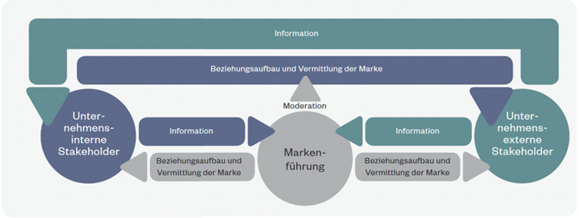
Quelle: absatzwirtschaft 11 / 2017
Brand relationships – from brand value to consumer value
The relationship of consumers to the brand is gaining immense importance through digitalization. More important than brand value in the future will be what the brand means to consumers. Where it used to be about “having” something or “being” someone, today it is more about “becoming” something or someone – this concept characterizes the so-called “experience society.”
Moreover, the digital platforms where advertising now takes place are fundamentally “conversational in nature,” and therefore brands need to adapt their strategies to do so, so that customers in the experience society feel they are being directly addressed. Through direct online communication with companies, consumers also have the opportunity to help shape the brand through recommendations and retellings.
Conclusion
There are many new challenges in brand management for companies that arise from digitization. But the example of the BMW Group shows that you have to be open and willing to develop and try out new strategies, methods and models in order to transform and develop the brand. Furthermore, it is very important to create a culture within the company that accepts progress and change, because only through the flexibility of structures and employees can brands develop a stronger cultivation capability.